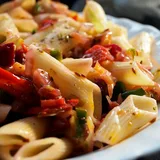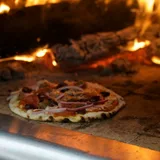
01“The pizza is as good as it gets on Queen, but plan to wait for a table on a Friday.
Ten sections. Each one answers a question you would ask before signing a lease, and every figure carries its source.
Should I do this at all?
Weighted across 6 factors: competitor density, ratings, concentration and survival rates.
14 competitors in 5km radius (0.09/1k people vs. 0.25 threshold).
HHI = 1,140 (moderate market).
Avg competitor quality: 4.21 stars (Google ratings less 0.4 star inflation). Gap to 4.5 star benchmark = 0.29 stars (buying peaks at 4.0 to 4.7 stars, Spiegel Research Center).
9,842 total reviews in area (benchmark for this industry: 6,000).
Canadian services-producing businesses: ~68% survive 5 years, against 68% for all businesses (StatCan/ISED Key Small Business Statistics 2025).
14 total competitors identified within 5km.
Method: StatCan/ISED business survival rates, DOJ HHI method, Spiegel Research Center rating study and Google vs Yelp rating gap. Density, demand and saturation thresholds are Scotell calibrations.
What each section adds to the verdict
Fourteen rivals within 5 km average 4.4 stars, yet only five hold 4.5 or better and none runs a weekday prix fixe. The eleven requirements are routine filings.
Rivals around Toronto in Italian restaurant, ranked by rating weighted against review volume. Ratings run from 3.9 to 4.8 stars.
01“The pizza is as good as it gets on Queen, but plan to wait for a table on a Friday.
02“Best margherita in the west end, and the lunch deal is hard to beat.
03“The cacio e pepe alone is worth the trip. Book ahead on weekends.
04“Great patio and the kale salad is famous for a reason. Service was slow though.
05“Every dish was a hit and the staff remembered us from our last visit.
06“Perfect for a quick espresso and a pastry, less so for a proper dinner.
Ranked by rating × log of review count · 14 of 14 competitors inside 5 km · top 6 shown
Competitor data sourced from local business listings, scanned 5 km at report creation time with all results stored. The radius slider filters stored data in your browser, with no new search. Ratings and review counts are shown as listed; no score is computed from them.
Licences, permits and filings for an Italian restaurant in Toronto, critical first. Tick each one off as you clear it.
What gates opening day
Critical items first; the amber underline marks them.
How the 11 requirements split
Every food premises is inspected before it opens and then up to three times a year. The result is posted at the entrance and online.
Ontario Regulation 493/17 requires at least one certified food handler or supervisor on site whenever the kitchen is open.
Any business that prepares and serves food to the public in Toronto needs this licence before it opens, renewed every year.
Required to sell or serve wine and beer on the premises. The AGCO checks the floor plan, capacity and the City’s sign-off.
Lets the restaurant put seating on the curb lane or sidewalk out front for the patio season.
Register a Business Number and open a GST/HST account to charge 13% HST on meals and file returns.
Withhold and remit income tax, CPP and EI from staff pay, tips included where they are controlled by the employer.
4 more in the full report, under Employment and Zoning & Building. Always confirm requirements with your local business licensing office before you apply.
CA$48,660.32 across 10 priced items
From published sources for Toronto. We do not guess sales.
Checked on each program’s official page on Sep 11, 2026.
The most each program lends or grants. Log scale.
Up to CA$500,000 for equipment and leasehold improvements. Rate capped at prime + 3%, 2% registration fee.
Up to CA$25,000 from Futurpreneur plus up to CA$50,000 from BDC, with a two-year mentor.
A grant of up to CA$5,000 after a training cohort, matched by your own contribution.
Toronto’s Italian dining market is mature and crowded at the top, but the independent neighbourhood room is where the growth is. Diners are trading chain menus for handmade pasta and a wine list they cannot find elsewhere.
The figures the sources report for Italian dining in Toronto, and for the city around it.
4 trends, each with its source and how soon it lands.
Set menus of two or three courses priced under CA$50 are pulling Tuesday to Thursday covers back into neighbourhood rooms.
An open pasta station is the reason diners cite most often for choosing an independent Italian room over a chain.
Toronto searches pairing natural wine with a neighbourhood name have roughly doubled since spring.
Independents are moving regulars onto their own booking and takeout pages to avoid 25 to 30% app commissions.
Read the quadrants together: the strongest opportunities are the ones your strengths can reach.
Core customer
Couples and friend groups aged 25 to 44 who live a short walk or streetcar ride away, eat out weekly and will pay CA$30 to CA$45 for a main.
The mapped radius
Both charts use the 14 rated competitors found inside the study radius, with live Google review data.
14 competitors by Google star rating
4 sit in the opportunity zone: rated 4.4+ with fewer reviews than the median (488)
Market figures are compiled from the sources listed; competitor ratings and review counts are live Google review data. Check the numbers that would change your decision before committing money.
18,400 Toronto searches a month, up 23% on the year, peaking in June to August. The pages that carry the niche are mostly blogs and local news.
5 of 26 measured phrases, searches per month
Peaks green, troughs amber.
Kinds of sites carrying this niche on the web.
The category's social conversation read like a Scotelligence Pulse: how big it is, how it feels, and what it feels.
Reddit and X hold most of the negative posts, and almost all of it is about waits and getting a booking.
Mean across kept posts
Kept posts, busiest first
Share positive at right. Reddit and X carry the complaints.
Which format beats the typical niche post on each platform, and when the niche engages most.
Engagement relative to each platform's typical niche post (1.0x).
Engagement by posting time, all platforms, Toronto time.
Friday 5 to 8pm leads by a distance; Thursday afternoon, when weekend tables get booked, is next.
Who drives this conversation, locally and city wide, and what people keep asking them.
Ranked by engagement on kept posts
Counted across posts and comments
The most engaged post on each platform, with the comments underneath. Comments are where the complaints and questions surface.
“Forty five minutes for a table on a Friday, even with a booking. The cacio e pepe almost made up for it.”
“Patio season is back and the cacio e pepe did not disappoint. Ask for the table by the vines.”
“Best handmade pasta in the west end that is not $30 a plate and not booked out for three weeks?”
“Anyone know a good Italian place nearby for a birthday dinner of 12? Every private room we tried is booked till November.”
“I ate cacio e pepe at every trattoria between Bathurst and Ossington. One stood out.”
Three moves, each tied to a block above.
Tags on the kept posts, most engaged first.
The one thing this week: Apply for the Toronto eating establishment licence. Plus 1 more in Months 1 to 2.
Allow 8 to 12 weeks. The public notice has to hang in the front window for 15 days.
Government-backed, up to CA$500,000 for equipment and leaseholds, rate capped at prime + 3%.
Every shift needs at least one certified food handler, so build the certificate into the offer.
Invite-only covers for three nights to test the line and the pass before the doors open.
Municipal Licensing & Standards. Book the DineSafe pre-opening inspection once the kitchen is fitted.
CA$25,000 plus up to CA$50,000 from BDC, with a two-year mentor. Open to founders aged 18 to 39.
Photos, hours and the menu up two months before service, with OpenTable linked from the profile.
Ontario Business Registry first, then a CRA business number with an HST program account.
Weekly price sheets from two suppliers keep the pasta and produce costs honest.
The headwinds this roadmap is built to absorb, each with the moves that answer it.
Labour shortages and high turnover are significant challenges in the restaurant sector. Retention costs are often underestimated.
Suggested actions
The restaurant industry carries compliance obligations that can result in fines or licence revocation if overlooked. Your report surfaced relevant regulatory requirements.
Suggested actions
The Action Plan is seeded from this report's regulations, plan milestones and funding sources, then kept by you. Tickets you move, date, finish or add are saved to the report and follow your account, not this browser.
Is handmade pasta takeout growing here?
Yes. Searches are up 27% and peak from November to February.
Real and rising. Four local creators post about it every week.